
At Tree-Nation, transparency and impact are at the heart of everything we do. The Verification Quality Score (VQS) is the framework we use to evaluate how each project in our portfolio is performing — combining on-site verification, satellite analysis, and field data into a single objective score.
We have just released VQS 2.0, a significant update to the framework that simplifies the scoring criteria and shifts verification weight away from project self-reporting toward objective field and satellite data.
You can view the VQS report on each project page in the Verification tab.
What is the VQS?
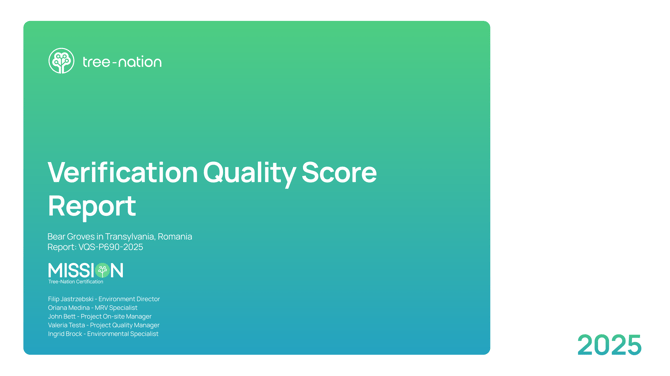
The Verification Quality Score (VQS) is an internal scoring system developed by Tree-Nation to assess and verify the quality of the reforestation projects we support. It combines on-site and digital verification methods to provide an objective evaluation of each project's environmental and socio-economic performance.
The score is updated annually and includes cumulative information gathered since the project joined Tree-Nation. Projects must meet a minimum VQS threshold to remain active on our platform. The VQS applies to all projects verified through the Tree-Nation methodology. Projects that carry their own external certification (such as Verra or Gold Standard) are verified through their certifying bodies' processes instead of through VQS.
What does VQS 2.0 evaluate?
The VQS evaluates each project across three tiers of criteria, weighted from most to least impactful on the final score.
Tier 0 — Core ecological and compliance criteria
The heaviest-weighted criteria, covering substantive ecological performance and compliance with project commitments:
- Survival rate compliance — actual survival measured on-site against the rate the project committed to in its Planting Order
- Forest health — change in Enhanced Vegetation Index (EVI) inside the planting polygon, measured by satellite, against baseline
- Maintenance period — number of years the project commits to maintaining the trees
- Final use of trees — the long-term intent for the trees, particularly relevant over the multi-decade horizons of agroforestry and farm-based projects
- Site integrity — whether the trees were planted at the location originally committed in the Planting Order
Tier 1 — Operational verification
How the project is delivering on the ground, verified against committed plans:
- Geotagged photos — photo provision, uniqueness, polygon coverage, and location accuracy
- Species mix — match to committed species composition, and whether planting volume meets the agreed quantity
Tier 2 — Communication & engagement
How the project communicates with sponsors and the platform:
- Update frequency — how often the project publishes updates
- Post integrity — how consistently project updates meet Tree-Nation's content and communication standards
- Update management — the project's autonomy in managing its own communications
What changed in VQS 2.0?
VQS 2.0 is a meaningful evolution of our verification framework. The headline changes:
Simplified criteria. We reduced overlap between evaluation dimensions and consolidated them into a clearer structure. Each criterion now maps to a specific aspect of project quality rather than competing for the same evidence.
Reduced weight on self-reporting. In VQS 1.0, project operators' own reports carried significant verification weight. In VQS 2.0, self-reported data still informs the score, but the verification weight has been shifted toward independently observable evidence.
Increased weight on objective field data. The weight that came off self-reporting has moved to objective, externally observable sources: Enhanced Vegetation Index (EVI) satellite analysis, geolocated field photos, and site development consistency checks between field reports, on-site visits, and satellite imagery.
Together, these changes mean that a project's VQS now reflects what we can independently verify, not what an operator says about itself.
Why was the VQS introduced?
Tree planting is more than just putting a seedling in the ground, it involves long-term maintenance, education, and community involvement. The VQS helps capture this complexity in a transparent way.
Until VQS reports were made public, this information was used only internally by our Environment Team. Now, sponsors can:
- See each project's progress and achievements
- Understand the areas for improvement
- Get full insight into our verification process
This initiative reflects our ongoing commitment to accountability, transparency, and continuous improvement.
Where can I see a project’s VQS?
To view the Verification Quality Score for any project:
- Go to the Project List
- Select the project you’re interested in
- Select the Verification tab (located after Reviews)
- You can open the full detailed report
For certified projects, the VQS report also includes a more detailed overview of progress per planting site, covering individual site monitoring status, field documentation, and satellite data — giving a complete picture of how each area within the project is developing.
These reports are designed to be easy to read and provide a complete overview of each project's verification journey.
Changelog
VQS 2.0 — May 2026
- Restructured criteria into three tiers (core ecological and compliance, operational verification, communication and engagement)
- Reduced verification weight on self-reported data
- Increased verification weight on objective field and satellite data
- Introduced Forest Health (EVI) satellite analysis as a Tier 0 criterion
- Introduced Site Integrity as a Tier 0 criterion (planting at the originally committed location)
- Introduced Final Use of Trees as a Tier 0 criterion (long-term intent for the trees)
- Expanded Geotagged Photos into structured sub-criteria (provision, uniqueness, coverage, location accuracy)
- Restructured Species Mix with compliance and planting-quantity sub-evaluations
- Removed planting-volume-based categorization
VQS 1.0 — 2022-2023 (Internal launch)
- Original Verification Quality Score framework introduced
- Annual scoring based on on-site and digital verification methods
- Minimum VQS threshold established for active project status on the platform
Want to share your thoughts?
We’d love to hear from you. Visit any project page, scroll down to the Reviews section, and let us know your feedback. Your input helps us continue to grow and improve our platform and our work with reforestation projects worldwide.
If you have questions or need help interpreting a VQS report, feel free to reach out to your Forest Success Manager or contact support@tree-nation.com.